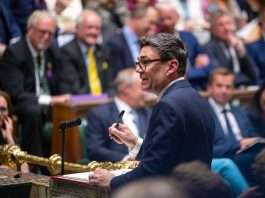
Andy Burnham has said Britain has evidence that Russia interfered in the 2016 Brexit referendum, becoming the first serving British prime minister to publicly acknowledge such interference.
The claim came in an interview with The Rest is Politics podcast, excerpts of which were released on Sunday ahead of the full episode on Monday. Burnham said he had raised the question after entering Downing Street in July.
“I asked the question coming to Downing Street: well, was there interference in the 2016 referendum from Russia? I’ve had the clear answer that, yes, there was,” he said.
Burnham did not identify who had provided the assessment, disclose the intelligence on which it was based or suggest that Russian activity had changed the referendum result.
On Monday morning, Foreign Office minister Stephen Doughty clarified the Government’s position in an interview with Sky News, saying Russia had attempted to interfere but had not succeeded.
“The security minister has spoken about this before, and he’s been very clear that they’ve attempted to, [but] they haven’t succeeded,” Doughty said.
Asked whether the referendum result was unsafe, Doughty replied: “No, I mean, the result is the result.”
The clarification draws an important distinction between attempts by a foreign state to influence a democratic process and evidence that those attempts affected the outcome.
Burnham’s remarks represent a departure from the position taken by successive Conservative governments, which maintained that there was no evidence of successful Russian interference in the Brexit vote. His statement has not, however, been accompanied by a published intelligence assessment establishing the nature or extent of Moscow’s alleged activity.
Downing Street declined to elaborate on the briefing received by the Prime Minister. Asked about the evidence, his spokesman referred instead to the Government’s wider national security measures, including powers under the National Security Act.
The question of Russian involvement in the referendum has been examined before, although the findings were considerably more limited than claims that Moscow influenced the result.
In 2020, Parliament’s Intelligence and Security Committee report on Russia criticised successive governments and intelligence agencies for failing to investigate potential interference in the EU referendum adequately.
The committee did not establish that Russia had changed the referendum result. Rather, it found that the Government had not sought a comprehensive assessment of potential Russian activity, despite concerns about state-backed media organisations and social media accounts seeking to influence political debate.
It also noted that no post-referendum assessment comparable to the American investigation following the 2016 US presidential election had been commissioned.
The distinction matters. A failure to investigate possible foreign interference does not establish that an influence operation succeeded. Equally, the absence of a comprehensive assessment cannot be treated as proof that no attempt occurred.
The committee emphasised that identifying attempted interference by a hostile state was important regardless of whether it succeeded.
Concerns about Russian activity were not confined to the Brexit referendum. In July 2020, the Government stated in a written parliamentary statement that Russian actors had “almost certainly” attempted to interfere in the 2019 general election through the online promotion of leaked UK-US trade documents.
Burnham returned to the issue at the United Nations last month, warning about Russian information warfare and announcing a new National Centre for Information Defence.
His latest remarks extend that argument to the referendum which resulted in Britain’s departure from the European Union.
The Prime Minister said greater public awareness of foreign interference was particularly important for European countries facing growing political challenges.
“These things are important now to put clearly on the record and I believe help voters in Germany and France understand that some of this politics is instigated via our enemies, namely Russia,” he told the podcast.
“I think we’ve been too much on the back foot on that, actually, and we haven’t informed people sufficiently about the extent to which people are seeking to disrupt the political process from overseas.”
Burnham also referred to a conversation with German Chancellor Friedrich Merz during his visit to Berlin last week.
Discussing the Alternative für Deutschland (AfD), Burnham said Merz had raised concerns about the party’s alleged connections with Russia.
“He was saying to me that the AfD are clearly linked to Russia, funded, I believe,” Burnham said.
The remarks, reported following the podcast interview, reflect Burnham’s account of the conversation rather than independently verified evidence that the AfD receives Russian funding.
“There is certainly misinformation, disinformation that is emanating from Russia into German politics,” Burnham added.
Russia has consistently denied interfering in foreign elections. Its foreign ministry rejected the 2020 parliamentary report as an example of “Russophobia”.
The Kremlin’s denial remains part of the dispute, although it does not resolve the question of what evidence British intelligence agencies hold.
The political significance of Burnham’s remarks extends beyond the question of foreign interference.
At Labour’s annual conference last month, the Prime Minister announced that his Government would examine options for Britain’s future relationship with the European Union, including closer trading arrangements and the possibility of eventual EU membership.
He subsequently left open the prospect of a future manifesto commitment to another referendum, although no such commitment has been made.
A return to EU membership, the customs union or the single market would represent a substantial change from Labour’s previous manifesto position.
On Monday, Burnham is expected to address the House of Commons, arguing that failing to pursue a closer relationship with Brussels would amount to a “dereliction of duty”.
He is also expected to reiterate his assessment that Brexit has done “more harm than good”, presenting renewed cooperation with the EU as an opportunity to strengthen economic growth and immigration controls.
A Downing Street source said maintaining the existing relationship without pursuing a better agreement would be a “major dereliction of duty”.
The Prime Minister’s comments about Russian interference have therefore emerged as the Government prepares to reopen a politically contentious debate about Britain’s relationship with the EU.
Critics of closer European integration have questioned whether the allegations risk casting doubt on the legitimacy of the 2016 referendum, despite the absence of published evidence that foreign activity affected the result.
Conservative shadow Foreign Office minister Wendy Morton said threats from hostile nations “come in different shapes and sizes” and that attempts to interfere in British elections were “particularly concerning”.
However, she defended the referendum result.
“The result of the Brexit referendum is legitimate and its authenticity should not be questioned. The public made their decision and Andy Burnham’s attempts to turn back the clock to 2016 run against the best interests of our country,” she said.
The pro-Brexit campaign group Britain Unbound also criticised the Prime Minister’s intervention, describing his remarks as “another crude attempt to undermine the legitimacy of the decision that the British people made in 2016”.
The organisation acknowledged that foreign interference in British elections was unacceptable but argued that there was insufficient evidence to conclude that Russian activity had influenced the referendum outcome.
“It is also insulting to suggest that voters were so easily duped,” the group said.
Pro-EU campaigners offered a different interpretation.
Richard Kilpatrick of European Movement UK welcomed the public acknowledgement, saying campaigners had long suspected that the referendum could have been subject to foreign interference.
Naomi Smith, chief executive of Best for Britain argued that restoring EU membership should now be a priority.
The competing responses reflect a broader disagreement over the significance of the Prime Minister’s disclosure.
The Government maintains that Russia attempted to interfere in the referendum but did not succeed. Brexit supporters have emphasised the legitimacy of the result, while pro-EU campaigners argue that the disclosure reinforces the case for reconsidering Britain’s relationship with Brussels.
The referendum produced 17.4 million votes to leave the European Union, representing 51.9 per cent of votes cast, against 48.1 per cent for remaining.
Nothing published by the Government establishes that Russian activity changed that outcome.
The outstanding question is whether Downing Street will release the intelligence assessment underlying Burnham’s statement, provide further details to Parliament’s Intelligence and Security Committee, or explain what new evidence has emerged since the committee’s 2020 report.
Until then, the Prime Minister’s assertion remains a publicly stated Government assessment without the supporting intelligence being available for independent scrutiny.
Great British PAC reaction
Claire Bullivant, chief executive of Great British PAC, said:
“Andy Burnham appears determined to drag Britain back into the Brexit arguments of 2016, just as he opens the door to dragging us back into the European Union.
“Let me be absolutely clear. Any attempt by Russia or another hostile foreign power to interfere in British democracy must be taken seriously and investigated. But if the Prime Minister has new intelligence, he should publish what he lawfully can and explain precisely what it establishes.
“His own Foreign Office minister has confirmed that Russian attempts to influence the referendum were unsuccessful. So why raise these explosive allegations now, without presenting the evidence to the British public?
“17.4 million people voted to leave the European Union. They were perfectly capable of making up their own minds about the future of their country, and their democratic decision deserves respect.
“Britain needs a Prime Minister focused on the challenges facing our country today, not one reopening the battles of a decade ago while entertaining the prospect of taking us back into Brussels.
“Mr Burnham, if you have the evidence, produce it. But do not confuse allegations of foreign interference with proof that the British people’s democratic decision was somehow invalid. Brexit was a vote for sovereignty, and that decision must be respected.”