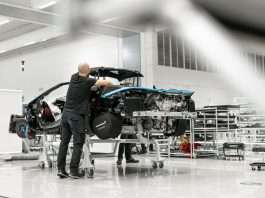
Wrightbus has lifted the curtain on its most advanced zero-emission bus yet – and it’s built right in the heart of Northern Ireland.
The company, based in Ballymena, has unveiled the Streetdeck Hydroliner Gen 2.0, the latest iteration of its trailblazing hydrogen double-decker – a world first when originally launched in 2020.
Touted as more efficient, cheaper to run, and capable of carrying more passengers than its predecessor, the Gen 2.0 is poised to cement Wrightbus’s reputation as a global leader in green public transport. Built entirely in Ballymena, production of the new vehicle is set to help the company smash records in 2025.

Unveiled at a launch event at the company’s factory, the Next Gen Hydroliner boasts a sleek new design and an impressive 300-mile range. It can be refuelled in just eight minutes – making it a viable like-for-like replacement for traditional diesel buses.
The second-generation bus has been redesigned from the ground up, in a four-year project partly funded by the UK Government via the Advanced Propulsion Centre UK (APC). Key partners in the initiative include Grayson Thermal Systems, Queen’s University Belfast, HYGEN and Translink – all focused on boosting UK-based manufacturing of cutting-edge hydrogen technology.
The bus features the latest hydrogen powertrain innovations, including a new fuel cell from Ballard and a highly efficient electric traction system. It also includes enhanced safety features, such as a redesigned front end built with vulnerable road users in mind, and improvements to accessibility.
Jean-Marc Gales, CEO of Wrightbus, said:
“We are delighted to unveil our next-generation hydrogen bus, which really showcases the breadth of knowledge and innovation we have here in Northern Ireland at Wrightbus, and in our UK supply-chain partners.
“Our development team have ensured this flagship bus is more efficient, travels further, costs less and is easier to service and maintain, and we are grateful to the APC and the Department for Business and Trade for their assistance with funding half of this project.
“Alongside our market-leading EV bus, 95% of all buses produced by Wrightbus at our Ballymena factory are now zero emissions – a marked change on 2019, when 95% of all orders were for diesels.
“We are truly leading the charge to net zero.”
Philippa Oldham, Stakeholder Engagement Director at the APC, added:
“This fuel-cell powered bus shows the opportunity to commercialise this technology.
“Buses are an integral part of the public transport network, with over 30,000 diesel buses operating across the UK and Ireland. Buses around the globe have to operate within a variety of constraints, whether it be related to topography or loading demands.
“This means that there needs to be a variety of options for this sector and the success from this project shows that hydrogen fuel-cell technology is a great solution.
“We are excited to see the fruits of this investment from both industry and government.”

North Antrim MP Jim Allister, who was among those attending the launch, praised the company’s world-leading innovation:
“I’m delighted to witness another chapter of the Wrightbus success story, particularly in regards its innovative leadership in the hydrogen sector.
“Wrightbus is a remarkable story. Since it was rejuvenated under its current ownership, it has gone from strength to strength – not just in the number of jobs it has created, but in terms of technology and achievements, where it is leading the world in hydrogen technology.
“This is a sector that has unlimited potential going forward and it’s great to see Wrightbus in it at the ground floor building so successfully.
“It’s a really good news story not only for North Antrim, but for the whole of Northern Ireland.”
The launch comes during what promises to be a bumper year for the company. Wrightbus recently revealed plans to create up to 1,000 jobs in its supply chain and grow its own workforce to 2,500, thanks to a sharp rise in production.
Wrightbus is currently the fastest-growing bus manufacturer in Europe – and with the launch of the Gen 2.0 Hydroliner, it’s firmly in the driving seat of the zero-emission revolution.