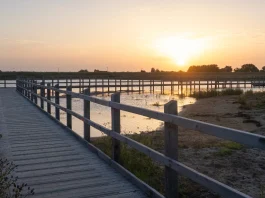
A pair of ospreys have bred at a confidential nest site in County Fermanagh, a first in Northern Ireland for more than 200 years.
This beautiful bird of prey has re-colonised naturally in the area and has successfully produced at least two chicks – the first known wild osprey chicks in Northern Ireland in modern times.
The historic discovery was made by Giles Knight, Environmental Farming Scheme Advisor with Ulster Wildlife, who has been observing the breeding pair for the last three seasons alongside his local farm visits in the area.
Mr Knight said:
“I have been keeping this news close to my chest for a long time to ensure the safety and welfare of these spectacular but vulnerable birds,” he said.
“Along with my son Eoin, I have watched the adults return to the same site since 2021, so you can imagine my excitement the moment that I saw three chicks and two adults this year. It was a rub-your-eyes, once-in-a-lifetime moment; an absolute highlight of my 30-year wildlife career – like finding long-lost treasure.
“With at least two of the chicks fledging this season, this is a huge conservation success story and indicates a healthy wetland ecosystem with plenty of suitable habitat and fish to bring this apex predator back to our skies and plunging into the Fermanagh Lakelands. Truly the return of a living countryside!”

The osprey is a magnificent bird of prey, with a wingspan of more than 1.5 metres. The birds spend the winter in West Africa and return to the UK each spring to refurbish their large stick nests and breed.
Often mistaken in flight for a very large gull or a buzzard but has a characteristic ‘M’ shape flight profile made by bending its wings.
The osprey is a fish-specialist, rarely eating anything else. It is usually found near water, including freshwater inland rivers and loughs as well as coastal estuaries and shorelines.
Its nest, called an eyrie, is generally built on the top of a large tree, usually a conifer, but deciduous trees are also used. In parts of their range, ospreys may nest on cliff ledges, man-made platforms and even on the ground.
Ospreys often nest in the same treetop eyrie for up to 20 years and are largely monogamous and strongly faithful to both nest and mate.
Ospreys were persecuted into extinction in the UK during the 1800s. They were shot for taxidermy and collectors took their eggs. The last recorded breeding took place in Scotland in 1916 and ospreys also disappeared across much of Europe – reaching a low in the 1920s and ‘30s. It was a combination of good luck and legislation to protect these birds which enabled the osprey population to recover.
Mr Knight added:
“Now these birds are back in Ireland and breeding successfully, it is critical that they are left in peace so their numbers can continue to grow by returning year on year to breed. We believe and hope that this could be the start of a raptor dynasty.
“It has been both encouraging and heartwarming to see the landowner, the local farming community and our partners welcome the ospreys’ return. Their ongoing support will enable future generations to enjoy these magnificent birds far into the future.”
Across Ireland, osprey monitoring, the erection of nesting platforms, and planning for translocation and re-introduction programmes have been ongoing for many years. These efforts have now been boosted by Fermanagh’s naturally established pair.